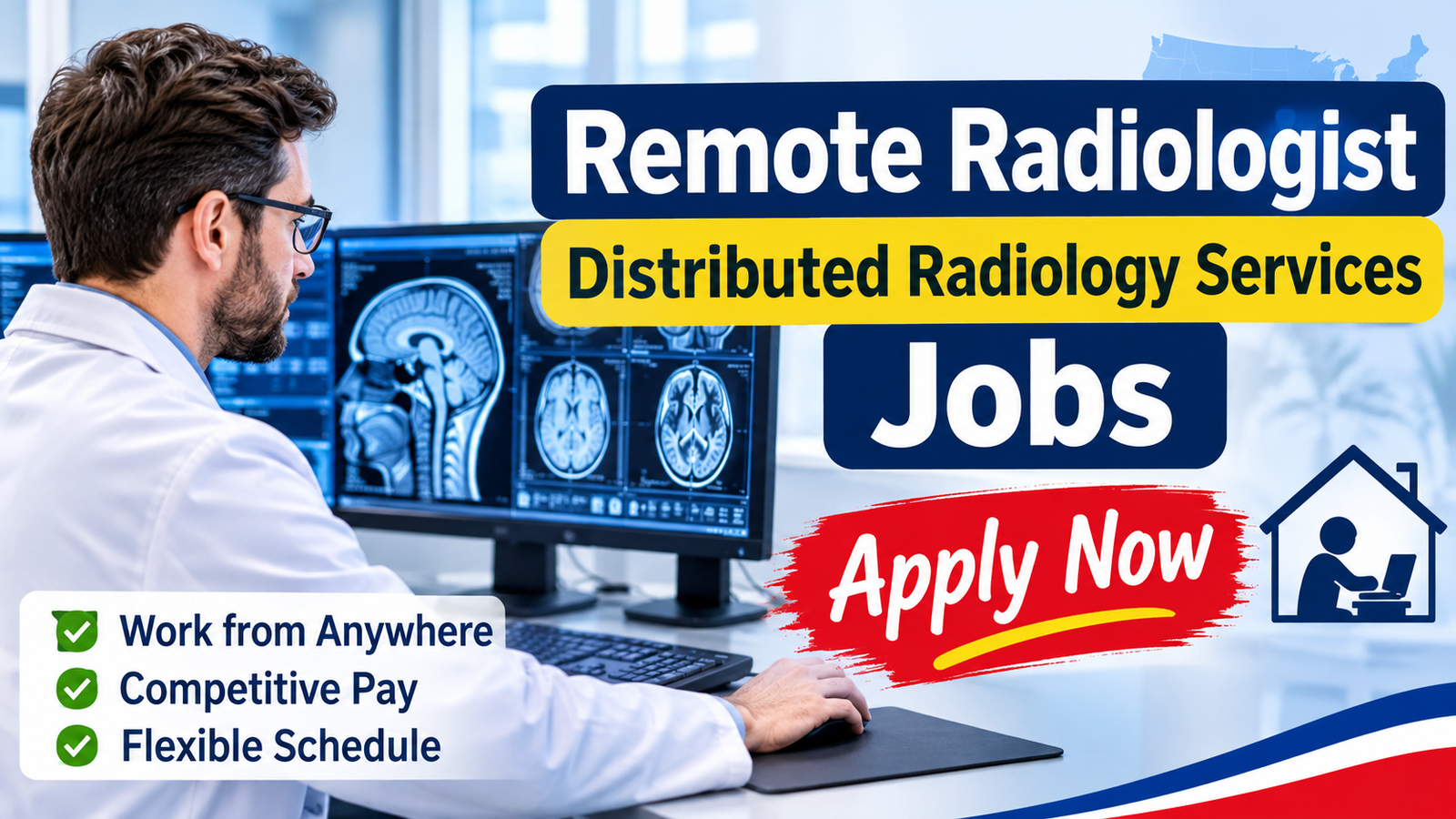
In the United States, board-certified radiologists are increasingly moving away from the traditional hospital reading room setting to distributed radiology networks. Companies such as Distributed Radiology Services and big national Teleradiology firms provide fully flexible, production-driven income and algorithm-based worklist management, all done remotely. It includes information about the verified job requirements, compensation ranges, work models and step-by-step application instructions for established physicians seeking.
Remote Radiologist Jobs Distributed Radiology Services 2026
Board Certified General Radiologists provides many availability levels (Full-Time, Part-Time, Per Diem, and Moonlighting) in multiple shifts based on Eastern Time (ET). Focused on 1st and 2nd-shift diagnostic reads with integrated AI-power tools. It is dedicated 3rd-shift coverage, Early Overnight (8:00 PM – 4:00 AM ET) and Overnight (12:00 AM – 8:00 AM ET). The salary of this post is $350,000 to $600,000 annually, heavily scaling based on your chosen schedule, workload, and location.
Detailed Overview Of Remote Radiologist Job 2026
| Title | Details |
| Job | Remote Radiologist |
| Salary | $350,000 to $600,000 |
| Official Website | Daily Remote |
| Country | USA |
| Posted By | fulltimejobsnearme.us |
| Status | Open |
What is a Distributed Radiology Service?
Distributed radiology service is a technology-powered teleradiology network that sends diagnostic imaging (CT, MRI, X-ray, Ultrasound, and Nuclear Medicine) studies from hospital or urgent care centers to remote radiologists from home workstations in multiple states. Rather than each hospital department having a separate worklist, radiologists log on to a single worklist on a distributed network.
Core Qualifications & Requirements
These job opportunities are available in 100% remote roles with distributed radiology practices across the United States that have rigorous professional requirements:
- Medical Degree: From an accredited medical institution and must be either M.D. or D.O.
- Board Certification: American Board of Radiology (ABR) or American Osteopathic Board of Radiology (AOBR) Board Certified or Board Eligible.
- Licensure: Active state medical licenses (often employers will help with multi-state licensing and credentialing).
- Subspecialty Training: Fellowship training is preferred for the more specialized roles (such as Neuroradiology, MSK, Breast Imaging, Pediatric Radiology) while general diagnostic radiologists are broadly recruited for emergency/teleradiology shifts.
- Home Workstation: High-speed fiber internet connected to FDA cleared diagnostic display monitors that meet ACR technical standards.
Salary Ranges & Compensation Models
In distributed networks, there are two common types of compensation for teleradiology:
Production Based Pay (RVU / Work Unit Model): Pay increases are based on the volume of studies, complexity of the studies and the speed of turnover. Teleradiologists working primarily in high-volume emergency or overnight settings often earn between $500,000 – $800,000+ per year.
Salaried Employee (W-2) / Fixed Shift Rate: Salary from $350,000 to $600,000 per year, with comprehensive benefits (health insurance, 401(k) matching, paid malpractice with tail coverage, and CME stipends).
Overnight shifts (7-on / 7-off), holiday coverages and worklists for trauma / stroke are common worklists for which premium pay is offered.
How to Apply: Step-by-Step Guide
-
Double check your Licensing Portfolio: Collect all current state medical licenses, NPI number, state DEA registrations and ABR/AOBR certification information.
-
CV & Case Log Summary: Make sure that your CV includes the diagnostic modalities, such as CT, MRI, Mammography, and Nuclear Medicine, as well as your average daily RVU/case volume.
-
Apply via Official Job Boards: Apply directly through official job boards of your employers or medical recruitment sites like American College of Radiology (ACR) Career Center, vRad Careers, and ALM Teleradiology.
-
Full Credentialing & Licensing Support: After an offer is extended, you can work with the practice’s in-house licensing team to add state licenses based on your preferred reading schedule.
Note: If a healthcare company asks candidates to pay the application processing fee or buy an IT workstation out of their own pocket before they have been hired, be aware that this is a red flag indicating that the organization is not legit.